AI made coding easy. Building software is still hard.
Those two things are not the same, and treating them as if they are is one of the more expensive mistakes a founder can make right now.
What People Think Happened
The common belief is that AI removed the barrier to building software. That anyone can ship now. That the engineering team is no longer the bottleneck.
That's not wrong. But it's not right either.
What AI removed is the barrier to generating code. That's a meaningful distinction, and it matters more than most people want to admit.
Code is an input. Software is an outcome.
The gap between the two is everything that happens after you write the first line: validating that you are building the right thing, designing it in a way that holds together under real usage, specifying the engineering before you build it, reviewing what gets built, testing it properly, deploying it safely, and then running it - databases, APIs, scaling, security - once it is live.
None of that is writing code. All of it is what makes code into software.
AI has made the coding part dramatically cheaper. The coordination work around it has not moved. If anything, it has become more visible, because the bottleneck has shifted.
The Bottleneck Moved. Most People Didn't Notice.
Here is what I see happen with founders building with AI tools today. They get to a working prototype in days. Sometimes hours. The prototype looks good. It does the thing.
Then they try to ship it.
Suddenly there are questions nobody thought to ask. What are the actual requirements for this to work in production? Is the architecture going to hold when real users hit it? Has anyone reviewed the code? Has it been tested beyond the happy path? Where does the data live, and who has access to it? What happens when it goes down?
These are not AI problems. They are software delivery problems. They existed before AI. AI just moved the floor - you can now arrive at the moment where these problems surface faster and cheaper than ever before. That is good. But you still have to solve them.
Shipping a prototype is not the hard part. It never was. The hard part is what comes after.
What Solving It Actually Requires
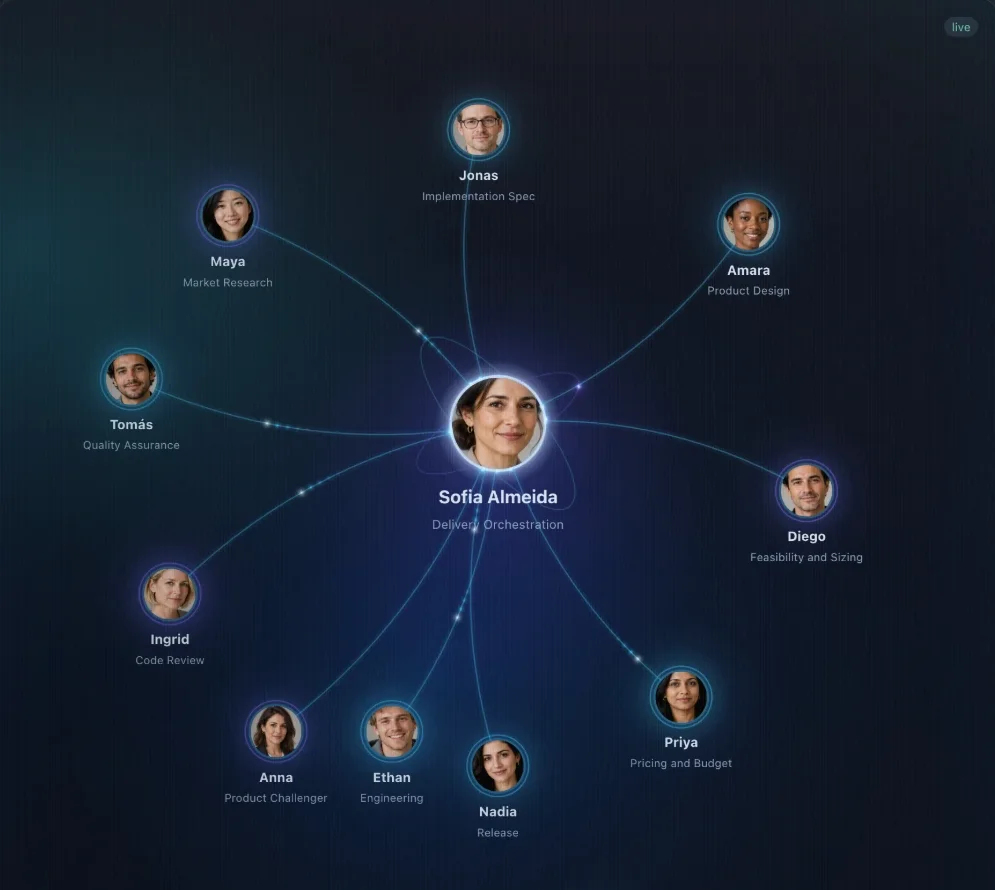
Getting from code to software requires coordination across multiple distinct functions: market research, feasibility assessment, product design, engineering specification, implementation, code review, QA, release management, and ongoing operations. Each is a different kind of work. Each requires different expertise. In a traditional engineering team, these functions are distributed across roles. The coordination overhead is real, but so is the coverage.
When you skip any of these, you do not save time. You defer the cost. And deferred costs in software are paid with interest.
What changes with AI is not that these functions become unnecessary. What changes is that a coordinated system of specialized agents can now cover them. Not one model doing everything. That does not work. The same way one generalist cannot replace a product team, one AI model cannot replace a delivery system.
The architecture matters. Specialization matters. Coordination matters.
A research agent is different from a design agent. A design agent is different from an implementation agent. An implementation agent is different from a code reviewer. Each operates in a distinct domain with a distinct objective. What makes the system work is not any individual agent - it is the structure that connects them and the sequence that governs them.
If you can't describe that structure, you don't have a delivery system. You have a tool.
The team shown in the image above - Sofia coordinating Maya, Jonas, Amara, Diego, Ethan, Ingrid, Tomas, Nadia, Priya, and Anna - each covers a distinct function. That is what 19 Agents is built around: specialization, not generalism.
What This Actually Unlocks
The practical implication is significant.
A founder who could not previously afford an engineering team can now ship production software. Not a prototype. Not a demo. Software, with the full delivery scope covered: the right thing validated before it is built, the architecture designed to hold, the code reviewed by something other than the person who wrote it, QA done properly, and then operations handled after launch - database, APIs, scaling, encryption, security - on their own domain or one provided.
That is a different kind of access than what AI coding tools offer. Those tools accelerate the coding step. A coordinated AI delivery system covers the whole scope.
The distinction matters because most failures in early-stage software do not happen at the coding step. They happen at the coordination steps that coding tools do not touch.
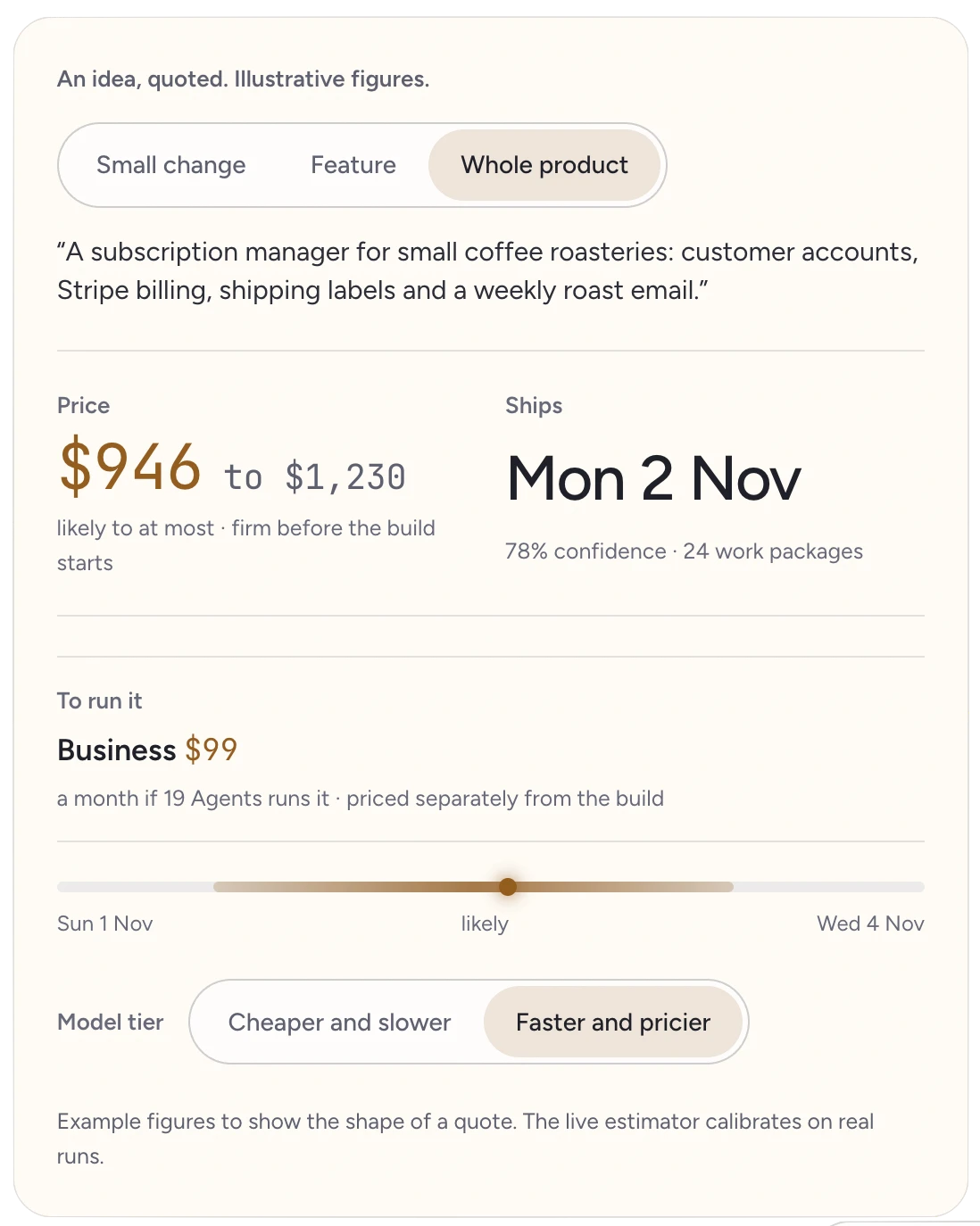
An idea, quoted. $946 to $1,230 fixed price - firm before the build starts. Ships Monday. $99 a month if 19 Agents runs it after launch. You approve the price before anything is built. 19 Agents is in closed beta - join the waitlist.
The Same Insight, Different Scale
This is the same argument I make to enterprise clients.
The organizations that get the most from AI are not the ones with the most advanced models. They are the ones that redesigned the system around those models. They built operating structures where AI does the kind of work it is actually good at, at the right points in the workflow, connected to the right handoffs.
Stop hiding behind individual tools, individual prompts, individual experiments. The gains do not come from any of that. They come from the system.
That insight applies at every scale. In a large enterprise, it means redesigning decision-making, workflows, and incentives around AI capability. In a software delivery context, it means building a coordinated team of specialized agents rather than prompting a single model and hoping for production-grade output.
The pattern is the same. The bottleneck is always coordination. AI makes individual steps faster. The system is what makes those steps compound.
The Bottom Line
If you can generate code faster than ever but you still do not have software at the end of it, the problem is not the code.
It is the system around it.
Most founders are optimizing the wrong thing. They are making the coding step cheaper when the coding step was never the constraint. The constraint was always what happens before, around, and after it.
That is the gap worth closing. And closing it does not require a bigger model or a better prompt. It requires a delivery system - research, design, specification, implementation, review, QA, release, and operations - working as one coordinated thing.
Code is what you have at the start. Software is what you ship at the end. The distance between them is not a technical problem. It is an operating model problem.
If this resonates with your organization's current state
A 2-week AI Delivery Diagnostic is the fastest way to understand the gap and what to do about it.
Book a call directly - no pitch, no commitment.