Companies spent $684 billion on AI in 2025, and most of it will not pay back. More than 80% of AI initiatives are failing to deliver meaningful business value, with the average sunk cost per abandoned initiative now exceeding $7 million. At the same time, DORA studied more than 5,000 engineering teams and found something more revealing. Over 95% of those teams are already using AI tools, and individual productivity is up by roughly 21%, yet delivery metrics at the team and organizational level remain flat.
That is the paradox. The tools are working. The individual gains are real. But those gains are not compounding into better outcomes for the business.
The reason is not the AI. It is the operating model.
Most companies are trying to layer AI onto systems, incentives, and decision-making structures that were designed for a slower, more predictable world. AI has changed the speed and shape of execution, but most organizations have not updated how decisions are made, how work flows, or how accountability is defined. That mismatch is now the primary source of lost value, and it is widening every quarter.
Where Value Actually Dies
The failure is not happening at the point of tool adoption. It is happening in the system those tools operate in. And because AI is not a solution layer but an amplification layer, the consequences of a mismatched system do not stay flat. They compound.
AI compresses cycles, but most organizations still plan in quarters. AI enables execution at the edge, but decisions are still escalated through layers. AI allows individuals to operate across traditional boundaries, but teams are still structured around rigid roles and handoffs. AI makes iteration cheap, but roadmaps are still treated as fixed commitments. The system slows down what AI speeds up, and the additional capacity AI creates never reaches the customer. It gets absorbed by coordination, rework, and delayed decision-making.
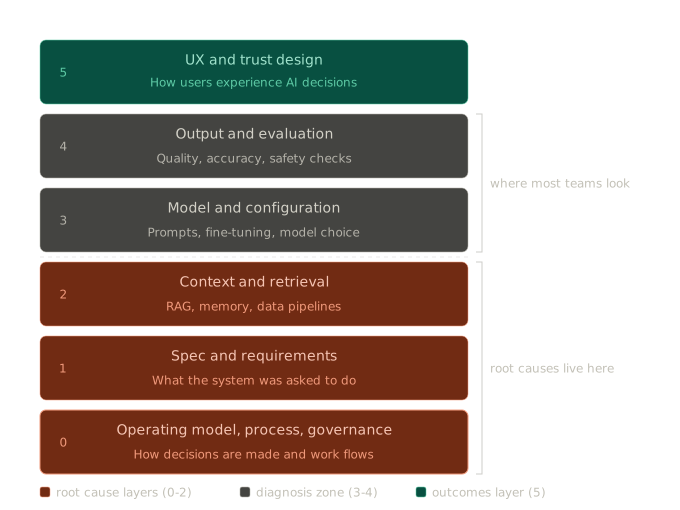
The AI Failure Stack - most teams diagnose at layers 3-4. Root causes are almost always at 0-2.
If your strategy is unclear, AI will help your teams execute faster in the wrong direction. If your prioritization is weak, AI will generate more options, more analysis, and more competing narratives without resolving the underlying lack of focus. If decision ownership is ambiguous, AI will produce more insights than ever before, but no one will be accountable for acting on them. This is why many organizations feel busier than ever while producing fewer decisions that actually matter. There are more dashboards, more reports, more intelligence, yet less clarity on what to do with any of it.
As one engineering leader put it: "We have more answers than ever, but we are less certain about what to do."
That is not a tooling problem. It is a leadership problem. AI increases throughput. It does not improve judgment.
The operating model determines which of those outcomes you get, and no amount of investment in better models changes that equation. Most companies did not fail to adopt AI. They failed to update the system AI is operating in.
The Winners Redesign the Operating Model First
The companies extracting real value from AI are not doing anything particularly unique with tools. Those tools are widely available and increasingly commoditized. What differentiates the leaders is not which AI they use. It is how they work.
They are not asking how to integrate AI into existing processes. They are redesigning those processes entirely. Decision-making is pushed closer to where information exists. Planning shifts from static quarterly cycles to continuous prioritization. Prototyping replaces long upfront definition. Handoffs are reduced because individuals can now operate across boundaries that used to require multiple layers of coordination.
McKinsey has observed that companies capturing the most value from AI redesign workflows end to end rather than embedding AI into existing processes. That distinction is critical. Embedding AI into a broken system makes the broken system faster. Redesigning the system changes the outcomes it produces.
This is where most organizations hesitate. Changing tools is easy. Changing how decisions are made and how accountability is structured is not. That is also precisely where the leverage is.
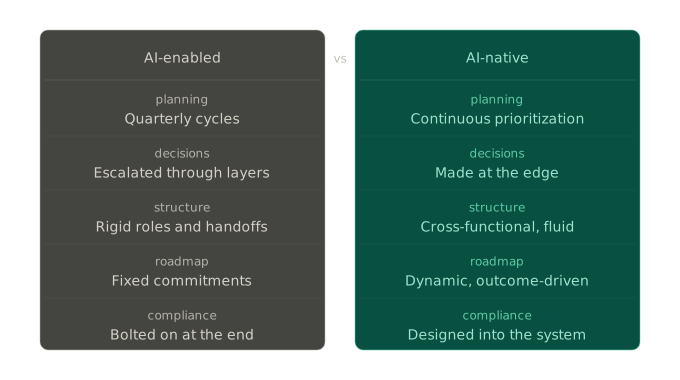
AI-enabled organizations use AI within existing systems. AI-native organizations design systems around what AI makes possible.
Most organizations are AI-enabled. The ones pulling ahead are AI-native. AI-enabled organizations use AI within their existing systems. AI-native organizations design their systems around what AI makes possible, and that design choice shows up in every layer: how decisions are made, how risk is defined, and how teams are structured. The tools are the same. The operating model is not.
A Real Scenario
Consider a mid-sized fintech scaling its customer operations. They deployed AI tools to assist fifty support agents with drafting responses, summarizing cases, and recommending actions. Within weeks, response times improved and productivity per agent increased. Leadership felt confident the investment was working.
But a new bottleneck appeared.
Every AI-assisted response still required manual review by a compliance team before it could be sent. That review cycle took up to three weeks in edge cases involving regulated content. The result was predictable: faster drafting at the front of the system, but the same slow release at the end. Customer experience did not improve. Backlogs grew.
The initial conclusion was that the AI tools needed improvement. Teams iterated on prompts, tested different configurations, and refined output quality. None of it moved the needle, because none of it addressed where the problem actually lived.
The actual issue was the operating model.
Instead of optimizing the tools, the company redesigned the system. They embedded compliance logic directly into the AI workflow, creating guardrails that automatically flagged risk and allowed low-risk responses to bypass manual review entirely. They also redefined decision ownership so that agents could act within clearly defined boundaries rather than escalate every case.
The tools did not change. The system did. Within two months, response times dropped materially, backlogs cleared, and customer satisfaction improved. Not because AI got better, but because the system stopped blocking it.
Compliance Is a Product Strategy Decision, Not a Legal One
The biggest constraint to decentralized, AI-enabled decision-making is not capability. It is risk. This is where compliance enters the picture, and it cannot be treated as an afterthought.
The EU AI Act is frequently framed as a burden: a regulatory obligation that slows innovation, consumes engineering resources, and introduces complexity where speed is needed most. That framing misses the strategic opportunity entirely.
When compliance is bolted on at the end of the development process, it becomes a bottleneck by design. Every output requires validation. Every decision requires review. Every edge case requires escalation. The speed that AI enables gets absorbed by governance that was never built to move quickly.
When compliance is designed into the product from the beginning, the dynamic inverts. It defines clear boundaries within which teams can operate autonomously. It reduces the need for escalation. It allows organizations to move fast without introducing unacceptable risk. The fintech in the scenario above did exactly this: embedding compliance logic directly into the AI system so that speed and control were no longer in conflict.
There is also a longer-term competitive argument. Companies that integrate AI governance early tend to move faster over time, because they avoid the costly rework that comes from retrofitting controls into systems not designed to carry them. More importantly, they build trust. In enterprise markets, trust is a prerequisite for adoption, not a feature to add later.
Consider the GDPR precedent. Companies that built compliance-first in 2018 did not just survive the regulation. They built infrastructure their competitors could not replicate quickly. The same window is open now with the EU AI Act. It closes in August 2026. Companies that treat it as a compliance checklist rather than a product strategy decision will not just fall behind on regulation. They will cede a trust advantage that their competitors will spend years trying to close.
Compliance is not a legal problem. It is a product strategy decision. Trust is becoming a feature, and the organizations designing for it now will carry an advantage that is genuinely difficult to replicate.
AI Doesn't Scale Through Experiments. It Scales Through Discipline.
Many organizations are still treating AI as an experimentation layer rather than a core capability. Hackathons, pilots, and innovation labs generate activity, but they rarely produce sustained outcomes.
The issue is not experimentation itself. It is the absence of follow-through. Scaling AI requires the same discipline as scaling any other business function. Clear ownership, defined metrics, investment prioritization, and repeatable processes are not optional. They are prerequisites. Most organizations skip this step. They generate insights but do not integrate them into core workflows. They run pilots but do not scale them. They celebrate experimentation but avoid accountability. This creates the appearance of momentum without the substance.
The companies that succeed treat AI not as an initiative to be experimented with, but as a capability that must be operationalized. They embed it into workflows, assign unambiguous ownership, measure impact rigorously, and stop what does not work. A team that owns AI outcomes specifically, with metrics tied to customer impact rather than tool adoption rates, produces compounding results. A team that treats AI as everyone's side project produces compounding noise.
Discipline is what turns isolated productivity gains into durable competitive advantage.
Where the Real Work Begins
Most organizations do not have an AI problem. They have a decision-making problem that AI has made impossible to ignore.
If your AI investment is not compounding, the solution is not another tool. It is a structural redesign of how your organization operates. There are four moves that matter, and they have to be made in the system, not in the stack.
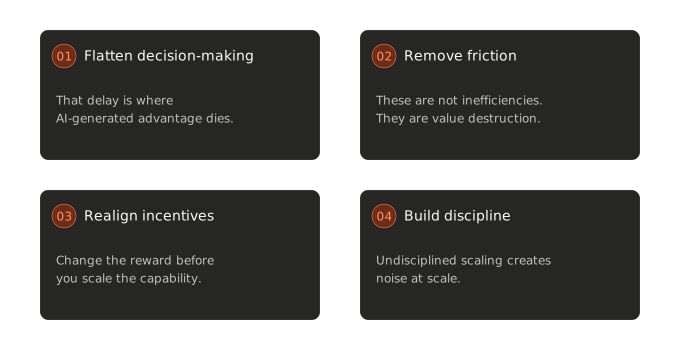
The four moves that turn an AI-enabled organization into an AI-native one.
The first move is to flatten decision-making. In most organizations, decisions are still escalated long after the information needed to make them is already available at the edge. The people closest to the problem wait for approval from people furthest from it. That delay is where AI-generated advantage dies. Map who owns decisions at each level and push that authority down to where the local information actually lives. Every round-trip up the chain and back is a delay that no model upgrade can fix.
The second move is to remove friction from the system. Map where work waits, where handoffs stall, and where decisions sit in queues. In an AI-enabled environment, these are not inefficiencies. They are value destruction. The pace of iteration has accelerated; the pace of coordination has not. Every hour a decision spends waiting consumes the advantage that AI created upstream.
The third move is to realign your incentives. AI amplifies whatever behaviors your incentive structures are already driving. If teams are rewarded for output (documents produced, features shipped, experiments run), AI will generate more of all of those things. If teams are rewarded for outcomes (customer impact, strategic clarity, problems actually solved), AI will generate more of those instead. The structure of the reward determines the direction of the compounding. Change the reward before you scale the capability.
The fourth move is to build operational discipline. Set clear priorities, define success metrics, track outcomes consistently, and stop initiatives that fail to deliver. This is not a new prescription. But in an environment where AI generates more options faster than ever before, the cost of skipping it is no longer recoverable. Undisciplined scaling of AI does not create momentum. It creates noise at scale.
Each of these moves, taken together, is a step toward the same destination: an organization that is not just using AI, but is AI-native.
The Bottom Line
The hard truth is that AI is not failing. Your operating model is.
This gap is not theoretical. It is already showing up in who ships faster, learns faster, and wins customers.
Most companies are still trying to fix AI outcomes with better tools. The companies pulling ahead are fixing the system that those tools operate in. That is the difference between incremental improvement and compounding advantage.
If this resonates with your organization's current state
A 2-week AI Delivery Diagnostic is the fastest way to understand the gap and what to do about it.
Book a call directly - no pitch, no commitment.