Too many companies are still scaling like it's 2020. The playbook hasn't changed. The constraint has.
Between 2019 and 2022, scaling had a clear logic: identify the throughput constraint, hire against it, add coordination layers to manage the new headcount, repeat. It worked because the constraint was real and visible. You needed ten engineers to ship what you wanted to ship. You had five. The fix was obvious.
That assumption is wrong now. And too many organizations are still running it.

What Changed
AI didn't just speed up human work. It changed what the bottleneck actually is.
When a PM can generate a full competitive analysis in an hour instead of a week, the constraint isn't research capacity anymore. When an engineer can ship a working prototype in a day instead of a sprint, the constraint isn't build capacity anymore. Output is no longer scarce. Output is cheap.
What's scarce now is different. Decision quality: AI generates more options, more analysis, and more recommendations than any team can act on. The constraint isn't information, it's the ability to make the right call from it, fast enough to matter. Specification clarity: AI builds exactly what you tell it to build. If the spec is vague, the output is wrong. Every time. System trust: AI can handle enormous volume, but only where humans are willing to let it operate autonomously. The constraint isn't capability, it's governance.
None of these constraints respond to headcount. You can hire a hundred people and still have all three problems. The organizations I work with consistently do.
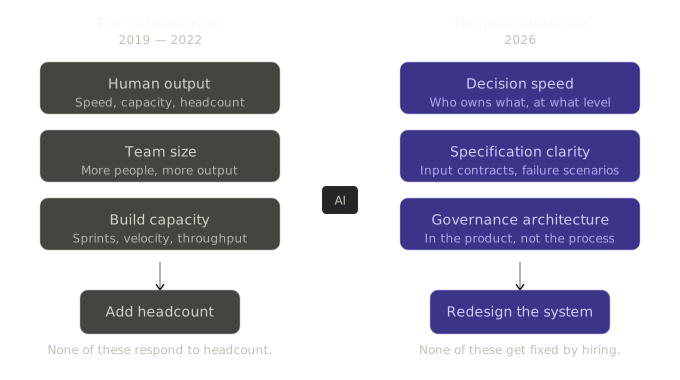
The old constraint was throughput. The new constraint is decision quality, specification clarity, and system trust. Adding headcount solves none of them.
The License Delusion
Many organizations think they have an AI strategy. What they actually have is a procurement decision.
They bought licenses. ChatGPT for everyone. Claude for the developers. Copilot for the whole company. Done. We're an AI organization now.
That is not a strategy. That is a spend line.
What they gave their people: access to a tool and instructions to figure it out. What they did not give them: a view of where AI creates value in their specific workflows. A framework for what good AI-assisted work actually looks like. Any shared understanding of what to spec, what to review, what to trust, and what not to. Any governance. Any measurement. Any accountability.
I sat with a product team recently — smart people, well-resourced, three different AI tool subscriptions. None of them were using AI the same way. Nobody had defined what good looked like. Nobody was measuring anything. Leadership had declared the company AI-forward and moved on. The team was left to figure it out alone.
Giving everyone a ChatGPT license and calling it AI transformation is like giving everyone a gym membership and calling it a health strategy. The infrastructure is there. Without a systematic approach — what to use it for, how to build the habit, what good looks like — almost nothing changes.
The sea of tools is real. The strategy is not.
And the people who suffer most are the capable professionals in the middle — the ones who know AI could help but have no framework for where to start, what to trust, or how to integrate it into work that actually matters. They're not resistant. They're lost. Nobody gave them a map.
88% Adoption. 6% Impact.
McKinsey surveyed organizations across every major industry in 2025. 88% use AI in at least one business function. Only one-third have begun scaling AI across the enterprise. Just 6% qualify as AI high performers — organizations actually seeing significant business impact.
88% adoption. 6% impact.
That gap is not a tooling problem. It is a system problem.
The 6% are running the same models as everyone else. What separates them: 55% of high performers redesigned workflows around AI capabilities, compared to just 20% of other companies. They didn't add AI to the existing system. They changed the system.
Everyone else paid for tools and ran them inside operating models designed for a pre-AI world. The tools speed up the work. The system slows it back down.
The New Constraint in Practice
I sat in a board meeting once where someone asked: if we cut the product team in half, what happens? Nobody had a good answer. That's on us.
The right answer, in a genuinely AI-native organization, should be: output doesn't drop, because output was never the constraint. Decision quality drops. Specification quality drops. The governance layer thins. Those are the things that matter now.
Too few product organizations can articulate this because they've never mapped what their actual constraint is. They measure velocity. They measure story points. Velocity only tells you how fast you're digging. Not if you're digging in the right spot.
In an AI-enabled environment, you can generate the wrong output at an extraordinary rate. Faster execution on the wrong problem is not progress. It's acceleration in the wrong direction.
The question almost nobody is asking: what slows us down now that AI has removed the human throughput constraint? The answer, in every organization I've worked with, is the same. Ambiguous ownership of decisions. Slow escalation chains. Workflows designed to be human-reviewed at every step. Governance that lives in a process instead of the architecture. Specifications that rely on tacit knowledge rather than explicit contracts. None of those problems get better when you add engineers. They get louder.
The Difference Is Not Adoption. It's Architecture.
The companies compounding from AI are not the ones with the most tools. They asked a different question.
Not: how do we integrate AI into what we're doing? But: if AI handles the execution layer, what does the organization need to look like?
The companies that unlock real value rearchitect how they build — not just for coding, but spanning ideation, requirements, design, testing, deployment, and operations, enabling continuous acceleration and compounding benefits. They push decision authority down to where information lives. They don't escalate what AI can resolve. They don't review what governance has already defined. They scale the system's capacity to handle volume, not the headcount.
One company went from 20-plus support employees to three humans supported by AI agents, while revenue swung from negative 19% to positive 47% year over year during the transition. That's not a cost-cutting story. That's an operating model redesign story. The humans in it moved to the work only humans should do.
Three Shifts That Actually Compound
Shift 1: Stop scaling headcount. Start scaling decision-making.
Who owns each decision? At what level? With what information? With what authority to act without escalation? In a pre-AI world, pushing decisions down was a risk. In an AI world, keeping them high in the chain is the bottleneck. Every unnecessary escalation absorbs the speed advantage AI created upstream.
Shift 2: Stop rewarding output. Start rewarding outcomes.
You don't get the product you plan for. You get the product you reward. If teams are measured on velocity, AI generates more velocity. If they're measured on outcomes — customer impact, revenue, adoption — AI generates more of those instead. The incentive structure determines what compounds. Many organizations changed the tools. They didn't change the incentive structure.
Shift 3: Stop optimizing workflows. Redesign them.
AI does not transform organizations. Redesigned work does. Organizations stuck at pilot purgatory are optimizing existing workflows with AI. The organizations compounding are asking what the workflow should look like if you designed it from scratch with AI as infrastructure. One produces incrementally faster bad processes. The other produces fundamentally different organizations.
The Bottom Line
Many organizations are not behind on AI adoption. They're ahead on adoption and behind on operating model redesign. That gap is where the investment disappears.
The scaling playbook nobody is talking about doesn't start with tools. It starts with the constraint. Find the real bottleneck. Redesign the system around it. Then scale.
AI didn't remove the constraint. It moved it.
Too many companies are still scaling the old one.
If this resonates with your organization's current state
A 2-week AI Delivery Diagnostic is the fastest way to understand the gap and what to do about it.
Book a call directly - no pitch, no commitment.