Most companies are about to repeat the same mistake they made in 2018. Just with higher stakes.
In 2017, the split was roughly even. Half of companies saw GDPR as an opportunity. The other half treated it as a burden to minimize. Eight years later, that decision is still showing up - in who wins enterprise deals, who moves faster, who built infrastructure their competitors still cannot replicate.
August 2, 2026 is the same moment. The same decision is on the table. Most companies are about to make the wrong call again.

The Readiness Reality
78% of organizations have not taken meaningful steps toward EU AI Act compliance. The deadline is four months away.
Most leadership teams know the regulation exists. Very few understand what it actually requires. And almost none have asked the more important question: what does it make possible?
Organizations already compliant with GDPR are better positioned - particularly in data governance, impact assessments, and documentation. But the AI Act goes further. Conformity assessments. Post-market monitoring. New territory for most compliance teams, and new territory for most product teams.
Most organizations don't have a compliance problem. They have a decision-making problem that regulation is about to expose.
What the Regulation Actually Requires
The AI Act operates on risk-based logic. Higher potential harm means more stringent obligations. Low-risk AI - spam filters, recommendation systems - operates freely. AI that impacts fundamental rights - employment decisions, credit scoring, biometric identification - is subject to rigorous oversight.
From August 2, 2026: full requirements for high-risk AI systems. Risk management, data governance, technical documentation, record-keeping, transparency, human oversight, accuracy, robustness, cybersecurity. All of it. Deployer obligations. Conformity assessments. Post-market monitoring. All enforceable simultaneously.
The extraterritorial scope mirrors GDPR. It does not matter where your company is based. If your AI systems produce outputs that affect EU residents, you are in scope.
Fines reach €35 million or 7% of worldwide annual turnover. For a mid-sized company with €50 million in global revenue, that is €3.5 million. Not a rounding error.
Compliance preparation for large enterprises runs $8 to $15 million. Mid-size companies: $2 to $5 million. Manageable when planned for. Significantly worse when compressed into a reactive sprint under enforcement pressure. Four months is not a lot of runway to build infrastructure.
The Wrong Frame
What most companies think they are doing: managing a compliance deadline.
What they are actually doing: making a market positioning decision.
Those two framings produce completely different organizations.
The company treating this as a compliance problem builds a compliance posture. Documentation produced. Boxes checked. Legal team satisfied. They will meet the regulation. They will not build a moat.
The company treating this as a strategy decision builds operating infrastructure. Governance frameworks that let teams move fast within defined boundaries. AI risk management embedded in the product from day one. Documentation that serves as a trust signal to enterprise buyers - not just a regulatory artifact.
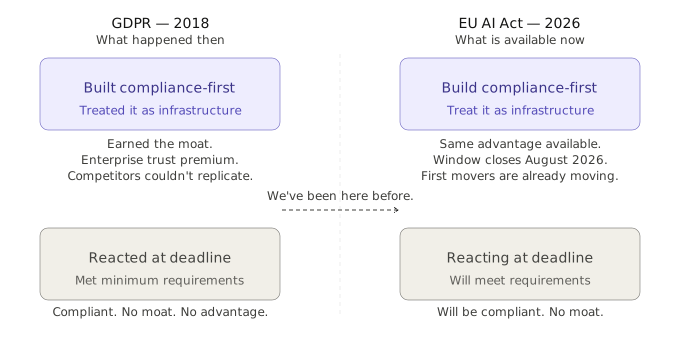
The GDPR parallel is not a coincidence. The companies that built compliance-first in 2018 built infrastructure their competitors still cannot replicate. The same window is open now.
GDPR showed us exactly how this plays out. Companies that built compliance-first did not just survive the regulation. They built data infrastructure that competitors could not replicate quickly. Companies that reacted at the deadline met requirements. They did not build anything that compounded.
The AI Act will produce the same split. Which side your organization ends up on is a decision you are making right now - not in August.
Compliance as Moat
Here is what most commentary on this regulation misses entirely. Compliance does not just change how you build. It changes who is allowed to compete.
The EU AI Act is not a quality bar every organization will eventually clear. It is a market filter. Some companies will build the capability to operate in this environment. Others will comply just enough to survive it. Those are two fundamentally different outcomes - and the gap between them compounds over time.
The mechanism operates through four channels.
Speed inside guardrails. When compliance is bolted on at the end, it becomes a bottleneck. Every output needs review. Every edge case needs escalation. The governance slows down the AI instead of enabling it. Design compliance into the product from day one and the dynamic inverts. Risk classification in the system architecture. Human oversight designed as a feature, not a process. Documentation generated automatically from the build. Teams move fast within defined boundaries. Governance enables speed.
I worked through this with a fintech recently. AI deployed across 50 support agents. Response times improved. Leadership celebrated. Then the bottleneck appeared: every AI-assisted response required manual compliance review. Up to three weeks in edge cases. Backlogs grew. Customer experience did not move.
The instinct was to fix the AI. Better prompts. Different configurations. None of it worked. The fix was redesigning the system - compliance logic embedded directly in the workflow, decision authority pushed to agents within defined boundaries. Response times dropped. Backlogs cleared. The tools did not change. The system did.
Enterprise sales differentiation. By Q4 2026, enterprise buyers in financial services, healthcare, and insurance will be asking suppliers to demonstrate AI Act readiness as a standard procurement requirement. Not as a nice-to-have. As a gate. The companies that can answer governance questions clearly will close deals faster. The ones that cannot will watch compliance become a sales blocker in the markets where they most need to grow.
Regulatory arbitrage. Some companies see compliance as an expense to avoid. Others see the competition retreating from Europe and focus on expanding into that market. You do not have to beat the competition when it is not there. The regulation creates market access for those who build to it and market exit for those who do not.
Investor and partner confidence. Penalty exposure under the AI Act is three-layered: regulatory fines up to 7% of worldwide turnover, the Product Liability Directive adding strict liability for non-compliant AI, and major insurers moving to exclude AI-related liabilities from standard policies. All three can land simultaneously. That risk profile is now a due diligence item. The companies that can demonstrate mature AI governance carry a lower liability profile and a higher trust signal.
What to Actually Do
With four months left, the sequence is not complicated. The execution is.
Stop and classify. Before anything else: conduct a full inventory of every AI system your organization develops or deploys. Classify each by the Act's risk tiers. Do this now. You cannot govern what you cannot see. You cannot prioritize what you have not classified. For the 40% of systems that fall into grey areas, build to the higher standard. The cost of proving a valid exception consistently exceeds the cost of compliance. Do not spend time arguing the boundary cases.
Put governance inside the product, not the process. This is the move most organizations get wrong. If governance lives in a review process, it will become a bottleneck. Always. You will be back to the manual review queue in six months wondering why nothing ships. If it lives in the product - risk classification logic in the system architecture, human oversight designed as a feature, audit-ready logs generated automatically - it becomes infrastructure. It enables speed instead of constraining it. If you cannot explain how your governance will make your teams faster, you have bolted it on at the end. Start over.
Make your documentation your sales asset. The technical documentation required under the AI Act - risk assessments, conformity procedures, monitoring records - should be organized to serve procurement conversations, not just regulatory ones. The same documentation that satisfies an EU notified body can differentiate your product in an enterprise sales conversation by Q4. Most companies treat compliance documentation as a defensive artifact. The companies building the moat treat it as a product asset.
Decide now, not in July. Businesses consistently need at least 12 months to comply with a single standard. Four months is not twelve. The organizations making the compliance-as-moat decision right now are not building a compliance posture. They are building operating capability that will compound for years. The organizations that wait until July are building the minimum viable posture. Compliant. No moat. No advantage.
Those are different organizations. The decision about which one you become is being made right now.
The Window
The GDPR parallel holds in one more important way: the window to build compliance-first rather than comply-by-deadline is time-limited.
In 2018, companies that started 12 to 18 months before the deadline built genuine infrastructure - defensible data architecture, governance processes that became competitive assets. Companies that started six months before the deadline met the regulation. That is all they built.
We are at the six-month mark for the AI Act. The infrastructure window is not closed. But it is closing. Every week of delay is a week of compounding advantage ceded to organizations already moving.
The Bottom Line
This is not a compliance deadline. It is a market filter.
Some companies will build the capability to operate in this environment. Others will comply just enough to survive it. The ones that build will carry the advantage for years - in deal velocity, in investor confidence, in enterprise trust, in the markets their competitors retreat from.
Stop hiding behind legal team timelines. Stop hiding behind budget cycles. Stop hiding behind "we'll get to it in Q3."
The EU AI Act is not a compliance problem. It is a strategy decision masquerading as one. The window is open now. It will not be open in August.
If this resonates with where your organization is right now
A 2-week AI Operating Model Assessment is the fastest way to understand your exposure - and what to do about it before August.
Book a call directly - no pitch, no commitment.